Uneven joists can quietly undermine a timber-floor project. Even when a room looks ready for floorboards, the timber below may be bowed, twisted, out of level or set at slightly different heights. Green Glue Joist Tape is fitted between timber joists and floorboards, but it cannot make an uneven joist structure flat.
We often see this issue in older UK homes, loft conversions and period properties. A few small variations are normal, but it is worth checking whether they could affect floorboard contact, fixings and the finished floor before any materials are fitted.
Stop Uneven Joists From Weakening Your Floor Upgrade
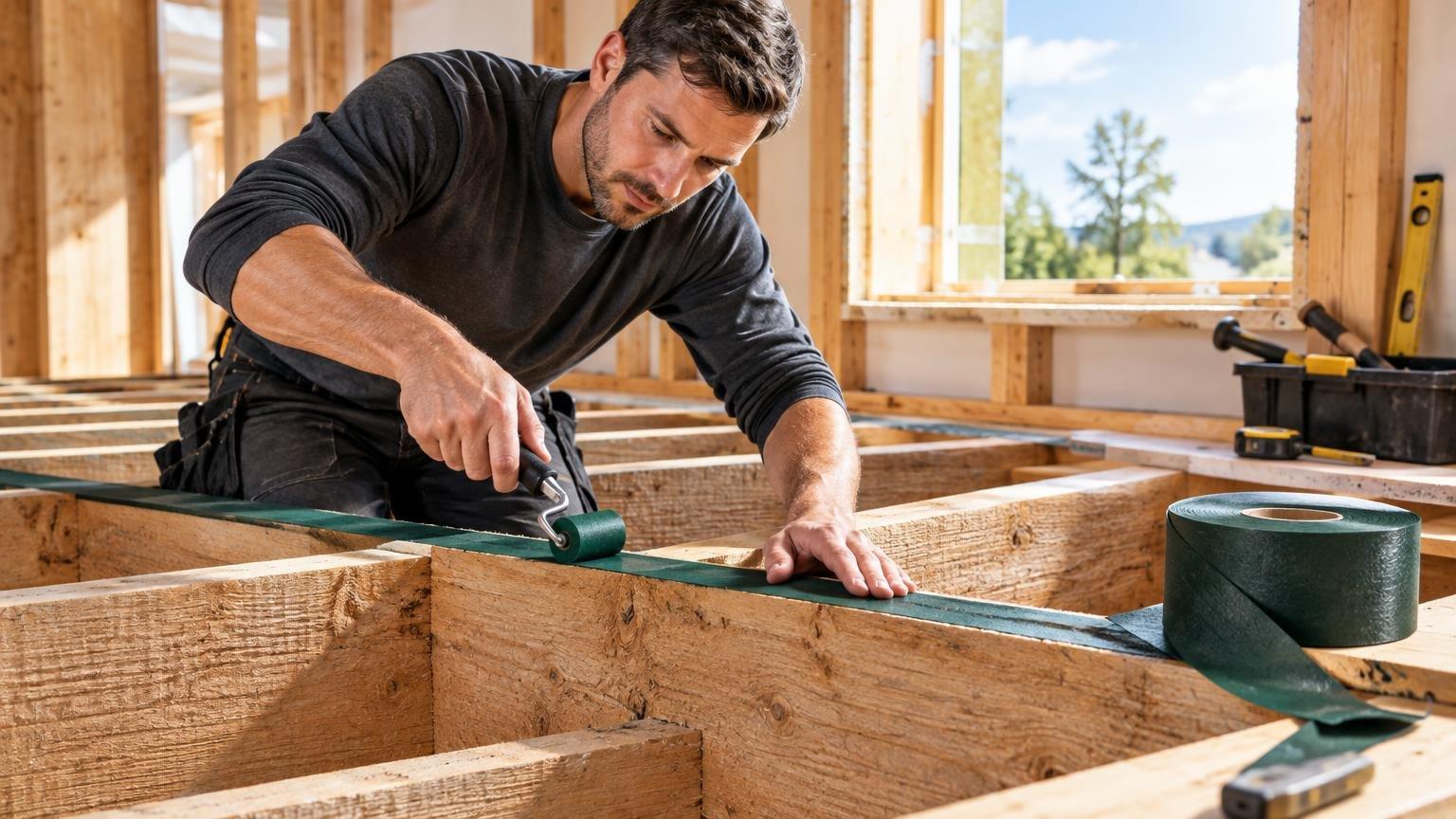
Green Glue Joist Tape is designed to sit between timber joists and floorboards. It provides a separating layer at the joist and floorboard contact points, which can help reduce vibration transfer through a timber-floor structure in homes, offices and residential spaces where quieter performance is the goal.
Still, soundproofing and levelling are two different jobs. The tape can accommodate modest surface variation, while levelling work deals with the shape and condition of the timber itself. If a joist sits proud of the rest, is badly bowed or has dropped lower than neighbouring timbers, floorboards may not sit evenly across the floor.
Minor imperfections do not always mean a major repair is needed. Timber moves over time, and older floor structures are rarely perfectly straight. The question is whether the variation is modest enough for the planned floorboard installation, or whether it is likely to leave gaps, create movement or cause uneven contact between the floorboards and joists.
Check Whether the Joists Need Repair or Preparation
Before fitting Green Glue Joist Tape, we recommend having the joists inspected carefully. A straightedge, string line or laser level can reveal differences that are difficult to spot from above. Looking across the joist faces is useful, but measuring their position gives a much clearer picture.
Signs worth checking include:
- High spots where one joist projects beyond the others
- Dips where a joist sits noticeably lower
- Twisting that leaves the joist face uneven
- Cracks, staining, rot or signs of movement
- Loose fixings, old nails or splinters on the joist face
Small surface variation may be manageable within the floor construction, particularly because Green Glue Joist Tape has some compressibility. Larger gaps and pronounced high spots are different. They can make floorboards harder to fit cleanly and may leave sections of board unsupported or with uneven contact on the joists.
Preparation depends on what the inspection finds. A qualified installer may plane a raised area, pack out a lower joist or sister a damaged timber to create a more consistent surface for floorboards. Where there is any concern about structural condition, movement or water damage, we recommend getting professional advice before fitting floorboards.
Use Green Glue Joist Tape Within Its Real Limits
Green Glue Joist Tape is part of a timber-floor construction, not a cure for every joist problem. When it is fitted along the top face of timber joists before floorboards are installed, it creates a separating layer between the timber and the floorboards.
The tape can follow modest irregularities in timber, but it will not fill deep hollows or straighten a bowed joist. It also cannot level a badly twisted or structurally damaged joist. If the underlying surface is significantly out of level, the floorboards may still follow that shape or fail to achieve appropriate, even contact.
Inconsistent contact is the main concern. A proud joist can take most of the load when floorboards are fixed, while lower joists may have lighter contact. In some cases, floorboards can bridge across low points altogether. That may affect the floor finish and make the separating layer less consistent than intended.
For that reason, we encourage you to treat Green Glue Joist Tape as a layer that supports prepared timber joists, rather than a product that replaces preparation. A reasonably even surface gives the floorboards and tape a fair chance to perform as planned.
Create a Flat, Continuous Contact Layer
Once the joists are in suitable condition, clean preparation makes installation more reliable. The top faces of the joists should be dry and free from loose dust, splinters and protruding fixings that could stop the tape sitting flat. A clean surface also helps achieve consistent contact beneath the floorboards.
Continuous coverage matters. The aim is to place the tape along each relevant timber joist so the floorboards are separated from the joists at their contact points, without unnecessary bare sections that may create direct contact.
For a tidy installation, we recommend that the project team pays attention to the following:
- Apply the tape neatly along each relevant joist face
- Avoid unnecessary gaps between taped sections
- Do not build up thick overlaps that create raised lines
- Check that no old fixings or debris can pierce the tape
- Lay floorboards carefully so they sit evenly on the prepared joists
Floorboards should not be forced over a severe dip or aggressively pulled down against a high joist with fixings. Doing so can create uneven contact and leave an untidy surface that becomes more obvious once the floor is in use. A smooth floor finish starts with the joists, not just the final floor covering.
Prepare Winter Floor Projects with Care
Autumn and winter are popular times for indoor work, especially when you want a home office, cinema room or music space ready for Christmas and the colder months. Yet damp voids, recent leaks and condensation can all affect timber condition. Before fitting Green Glue Joist Tape or floorboards, make sure the structure is dry and stable, and resolve any mould or water ingress first. Rushing to meet a seasonal deadline can lead to costly rework once the floor is finished.
The practical takeaway is simple: assess the joists early, correct meaningful unevenness and then fit the floorboards over a sound, reasonably level base. Green Glue Joist Tape can be a useful part of timber-floor construction, but it works best when it is not being asked to solve a structural or levelling problem.
Green Glue Joist Tape Is Not for Plasterboard Ceilings
Green Glue Joist Tape is not intended for decoupling plasterboard ceilings. Where an independent plasterboard ceiling is required, Advanced Acoustics recommends the MuteClip System. XP or LP Clips are ideal where the ceiling is uneven, helping to create an appropriate independent ceiling system without using Green Glue Joist Tape as a plasterboard decoupling product.
Build A More Reliable Acoustic Floor
Choose Green Glue Joist Tape for use between timber joists and floorboards to support a carefully planned timber-floor construction. At Advanced Acoustics, we can help you choose the appropriate product for either timber-floor construction or an independent plasterboard ceiling. For guidance before ordering, contact us and our team will be happy to help.